
How to Make Purple: What Colors to Mix, Ratios and Easy Fixes
By Zohan | Last reviewed: October 16, 2026
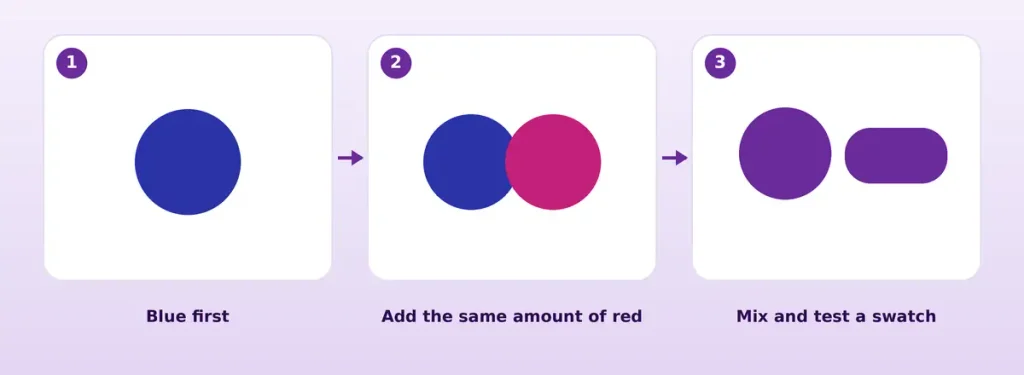
QUICK ANSWER: To make purple, start by mixing roughly equal parts of a blue-leaning red and a red-leaning blue, then adjust the ratio until you get the hue you want. Quinacridone magenta and ultramarine blue make a dependable pair for a clean, bright result. More blue shifts the mix toward violet, and more red shifts it toward red-purple.
Key facts:
- Basic starting ratio: about 1 part red to 1 part blue
- Cleaner purple: a blue-leaning red with a red-leaning blue
- Best starting pair: quinacridone magenta (PR122) and ultramarine blue (PB29)
- Muddy purple: often an orange-leaning red or a trace of yellow
- CSS purple on screens: HEX #800080, RGB 128, 0, 128
You squeeze out some red, add some blue, stir, and end up with something closer to brown than purple. It is one of the most common color-mixing letdowns, and it rarely means you did anything wrong. Most of the time, the red was simply the wrong kind of red.
Once you know how to make purple with the right pair of paints, the result changes straight away. Everything hinges on choosing a red that leans toward blue and a blue that leans toward red, so both colors pull in the same direction instead of fighting each other.
This guide walks you through which colors to use, a starting ratio you can adjust, a simple five-step method, the paint pairs that work best, and quick fixes for brown, gray or uneven purple. It also covers food coloring, crafts and screen colors, since purple works a little differently in each.
What Colors Make Purple?
Red and blue make purple in traditional paint mixing. Combine them in roughly equal amounts and you get a balanced purple that sits between the two on the painter’s color wheel, which is why purple is called a secondary color.
In traditional paint mixing, purple usually comes from a red-leaning pigment paired with a blue-leaning one. Digital screens and printing build purple through other combinations, covered further down this page.
Your choice of red and blue matters as much as the amount. Two tubes both labeled red can give you a bright purple or a muddy brown, depending on which way each paint leans.
Why Red and Blue Sometimes Make Brown
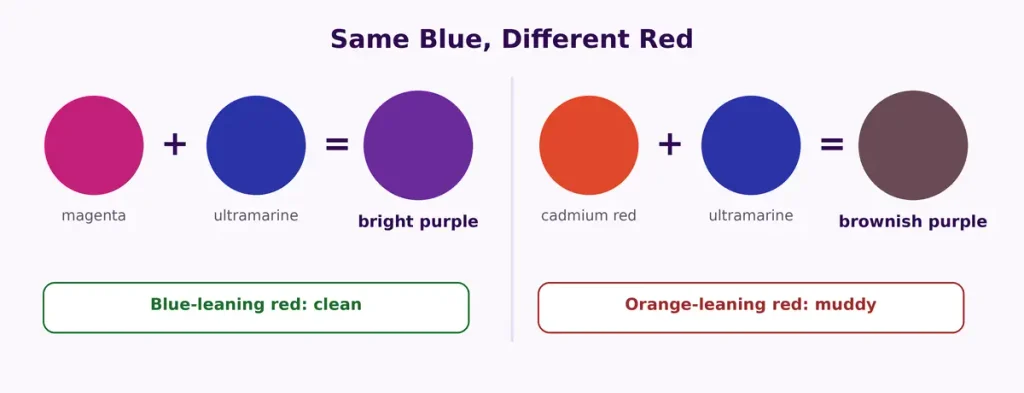
Color bias is the tendency of a paint pigment to lean toward a neighboring color on the wheel. Cadmium red leans toward orange, and orange carries some yellow, which is the complement of purple. When a complement slips into the mix, the purple dulls toward brown or gray.
Choosing paints that already lean toward each other solves this. Quinacridone magenta is a red that leans toward blue, and ultramarine is a blue that leans slightly toward red. Mixed together, they make a clean purple with nothing pulling the blend off course.
How to Make Purple With Only Primary Colors
Kids’ and student paint sets tend to come with one red, one blue and one yellow, and that red often leans orange. Still, a decent purple is possible from a set like this with a few simple changes.
- Choose the red that looks more pink or crimson rather than orange.
- Start with equal parts, then add a little more blue if the mix starts to look brown.
- Keep yellow off your brush and out of your rinse water.
- If you have pink paint or a magenta marker at home, use it in place of red for a much brighter purple.
How Much Red and Blue Make Purple?
One part red to one part blue is a good place to begin. That ratio gives a balanced purple in most paints, and from there you can push the mix warmer with extra red or cooler with extra blue.
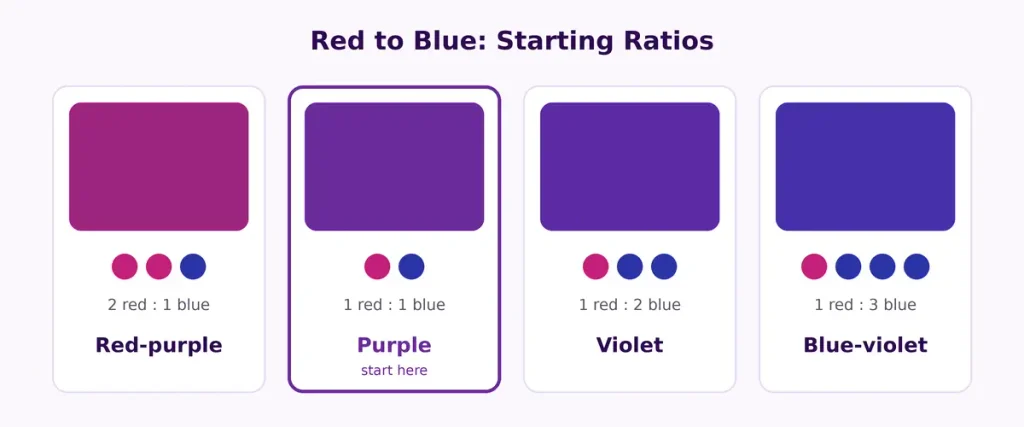
These ratios are starting points, not universal formulas. Pigment strength, color bias and the medium you use can all change the final result, so treat the table as a guide and adjust by eye.
| Target | Red | Blue | What you get |
| Red-purple | 2 part | 1 part | Warm, close to magenta |
| Purple | 1 part | 1 part | Balanced, the classic purple |
| Violet | 1 part | 2 part | Cool and blue-leaning |
| Blue-violet | 1 part | 3 parts | Close to blue |
Adding more blue shifts a purple mixture toward violet or blue-violet. Violet often begins around 1 part red to 2 parts blue, though the exact amount depends on your pigments. Our violet guide covers that mix step by step.
Tip: Magenta is a strong tinter, so a dab can shift a whole batch. Test a little swatch and let it dry before you mix a large amount.
Shifting the balance works best in tiny amounts, with the stronger color going into the weaker one. Even a rice-sized dot of blue can move a whole pile of red-purple toward violet, while pulling a blue-heavy mix back may take much more red. Stir fully after each addition and compare it with your last swatch.
Save This Purple Mixing Chart
Keep the ratios, the lighter and darker steps, the reliable paint pair and the quick fixes next to your palette with the cheat sheet below.
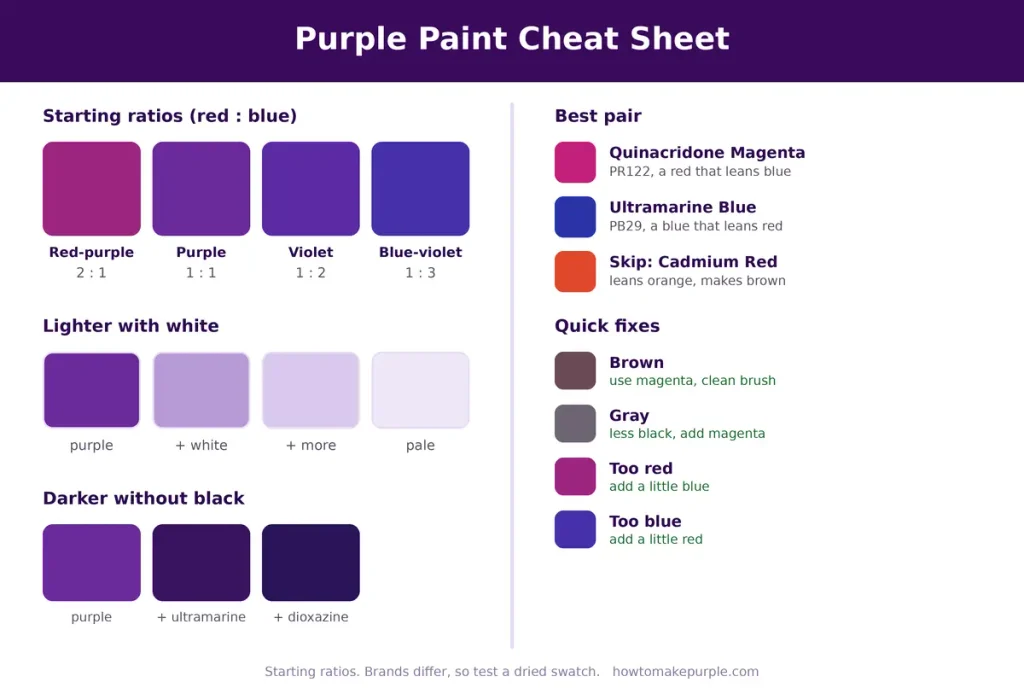
On a phone, press and hold the chart and choose save. Desktop users can right-click it to save the image, then print it at any size.
How to Make Purple Step by Step
This method works with acrylic, oil, gouache and poster paint. Two colors, a palette and a few minutes are all it takes.
What You Need
- Blue-leaning red, such as quinacridone magenta (PR122) or a crimson
- Red-leaning blue, such as ultramarine blue (PB29)
- White paint, if you want a lighter purple
- Palette knife or an old brush for mixing
- Paper or card for test swatches
Mix It in 5 Steps
- Squeeze out the blue first, about the size of a pea.
- Add a similar amount of red right next to it.
- Mix with a palette knife until no streaks of red or blue remain.
- Brush a small swatch on white paper and look at it in daylight.
- Let the swatch dry, then adjust with a touch more red or blue. Once you like the color, mix enough for the whole project and write down the ratio, because a second batch rarely matches by eye.
Small habits keep every batch clean:
- Work on a white palette or plate, so you see the true color.
- Rinse the brush between colors, since a speck of yellow can dull the blend.
- Hold back the white until the hue looks right, because white changes both lightness and lean.
- Judge the color in daylight, as warm indoor bulbs can make purple look redder.
Best Red and Blue Pairs for a Clean Purple
Pigment is the finely ground colored material in paint, and artist-grade tubes print a code for each one. Here is how common red and blue pigments tend to behave in roughly equal parts.
| Red | Blue | Typical result |
| Quinacridone magenta (PR122) | Ultramarine (PB29) | Bright, clean purple, a reliable all-round pair |
| Alizarin crimson (PR83) | Ultramarine (PB29) | Deep, cool purple. Traditional PR83 can have weaker lightfastness than many modern alternatives |
| Cadmium red (PR108) | Ultramarine (PB29) | Duller, brownish purple |
| Pyrrole red (PR254) | Phthalo blue (PB15) | Can produce a very dark, strongly saturated blue-violet or near-black mixture, depending on the specific pigments |
Making Purple in Paint, Food Coloring and Crafts
Combining colors works across many materials, but the exact colors and ratios depend on what you are working with. The sections below show how to adapt the method.
Paint
Acrylic, watercolor and oil all respond to the ratios above. Acrylic can look a little darker once dry, and ultramarine often settles into a soft, grainy texture in watercolor, so judge your purple on a dried swatch. Watercolor also lets you glaze, which means painting a thin layer of magenta over dry blue. Oil stays workable for a long time, so you can blend slowly and keep the ratio steady.
Food Coloring and Icing
Gel food colors work well because they tint strongly without thinning your icing. Many red gels lean pink, so start with roughly 2 drops of blue to 1 drop of red, then adjust one drop at a time, because gel strength varies by brand. Red cabbage juice and blueberry juice give soft, natural purples, though both can shift in color when mixed with acidic ingredients like lemon.
Clay, Resin and Slime
Polymer clay blends best by kneading a pea of red into a larger piece of blue, then working in more red until the purple looks right. Make a little extra, since clay colors are hard to match later.
Epoxy resin takes a resin dye or mica powder, added in tiny amounts, because a few drops can tint a whole cup. Slime is even simpler. Drip about 2 drops of blue food coloring and 1 drop of red into the glue before you add the activator, then adjust.
How Is Purple Made in Paint, Light and Print?
Purple is made in different ways depending on whether you see it in paint, on a screen or on printed paper.
Paint uses subtractive mixing, where pigments absorb part of the light and reflect the rest. Together, red and blue pigments reflect a purple color back to your eye.
Screens use additive mixing, where colored light is combined. On an RGB screen, red and blue light at full intensity produce magenta (255, 0, 255). Lowering the red and blue values together gives darker purple shades. CSS purple is RGB 128, 0, 128, which is HEX #800080. Another common screen purple, Rebecca purple, is #663399. Both are defined in the W3C CSS Color specification.
CMYK is the four-ink system most printers use: cyan, magenta, yellow and black. In CMYK printing, purple is usually built from magenta and cyan, with the exact proportions adjusted for the hue you want and the print process.
Lighter, Darker and Other Purple Shades
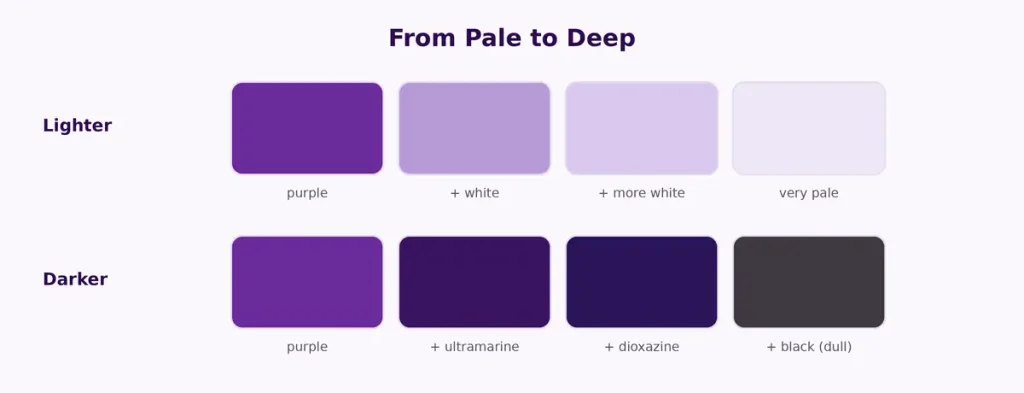
White lightens purple, a darker blue deepens it, and a hint of another color shifts its mood. Use this table as a quick reference.
| Shade | What to add |
| Light purple | White, mixed in gradually |
| Dark purple | Ultramarine or some dioxazine purple, before any black |
| Violet | Extra blue, starting near 1 red to 2 blue |
| Lavender | Plenty of white plus a touch of extra blue |
| Lilac | White with a hint of pink |
| Mauve | Purple softened with white and some grey |
| Plum | Slightly more red and a touch of dark blue |
| Royal purple | Rich purple deepened with extra ultramarine |
Lightening works best when white goes into the purple rather than the other way round. Purple overpowers white easily, so this wastes less paint. Pastel shades stay cleaner with a tiny touch of extra blue, which keeps the tint from turning pinkish.
Deep shades have their own walkthrough in our dark purple guide, which shows how to darken without going muddy. Every shade, with names and reference codes, is collected in all shades of purple.
Why Does My Purple Look Brown or Dull?
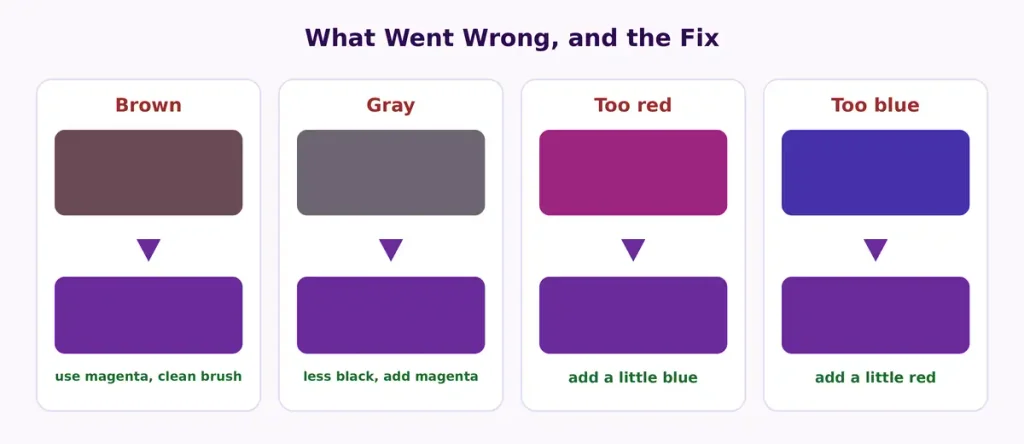
Purple tends to go wrong in one of five ways, and each one has a quick fix.
- Your red leans orange. Cadmium red, vermilion and many basic reds carry some yellow, which dulls purple.
- Yellow got into the mix. Even a dirty brush, palette or rinse jar can do it.
- Black went in too early. Black darkens purple, but it also grays it out.
- Too much red or pink shows up. Add blue in small steps until it settles back to purple.
- Blue takes over. Work in a little red or magenta and check after each addition.
Bring Back a Bright Purple
Slight dullness often lifts with a dab of magenta for brightness or ultramarine for depth. After a mix has turned brown, starting fresh with a clean pair is faster than trying to rescue it.
Can You Make Purple Without Red or Blue?
Purple-like colors are possible without a traditional red and blue paint pair. Magenta and cyan, for example, can create purple or violet hues depending on the medium and proportions, which is how printers build purple. Pink and blue can give a softer purple. Ready-made violet or purple pigments, such as dioxazine purple, are another option when you would rather skip mixing.
Purple Mixing at a Glance
- Ratio: begin near 1 part red to 1 part blue
- Paint choice: blue-leaning red plus red-leaning blue
- Bluer result: add blue for violet and blue-violet
- Proven pair: quinacridone magenta (PR122) with ultramarine (PB29)
- Warmer result: add red for red-purple
- Lighter: mix in white gradually
- Darker: use a dark blue or violet before black
- Muddy mix: look for an orange-leaning red or yellow on your tools
Frequently Asked Questions About Purple Making
Mix a Clean Purple Every Time
To make a clean purple, start with roughly equal parts of a blue-leaning red and a red-leaning blue, such as magenta and ultramarine. That is the heart of how to make purple in paint. Adjust in small steps, judge on a dried swatch, and use the shade table above when you want to go lighter, darker or bluer.
Written and reviewed by Zohan, founder and editor of How to Make Purple, where he researches and organizes practical color-mixing guides using pigment references and established color resources. Mixing results vary by brand, surface and lighting.
Last reviewed: October 16, 2026.