
How to Make Violet Color: What Colors Make Violet and How to Mix It
By Zohan | Last reviewed: October 15, 2026
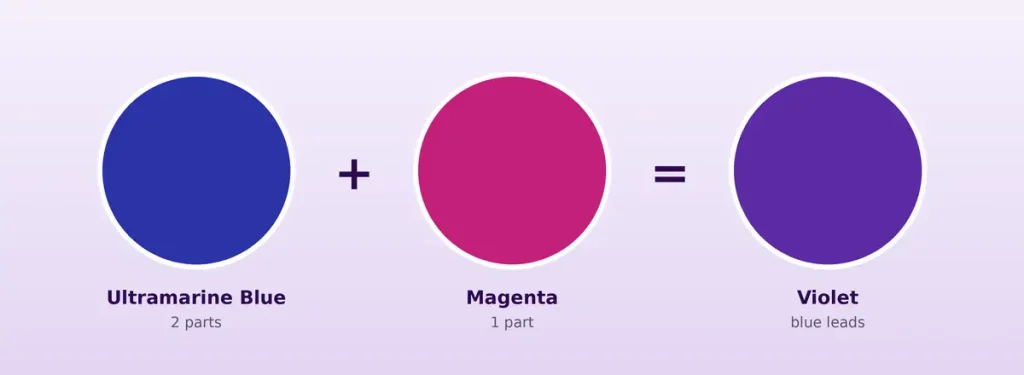
Quick answer: make violet, mix ultramarine blue with quinacridone magenta at about 2 parts blue to 1 part magenta. Blue must lead, or the mix turns into plain purple. Add white for light violet, more ultramarine or dioxazine violet for dark violet, and test a dried swatch before you paint.
KEY FACTS
- Best pair: ultramarine blue (PB29) and quinacridone magenta (PR122)
- Starting ratio: 2 parts blue to 1 part magenta
- Avoid: orange-leaning reds like cadmium red, and black for darkening
- Ready-made option: dioxazine violet (PV23)
- Screen reference: #8F00FF for vivid violet, CSS darkviolet #9400D3
Learning how to make violet color starts with choosing the right blue and red. If your mix keeps turning purple, pink or muddy, the balance between those two paints is usually the cause, and you can fix it in a few minutes.
Maybe you mixed red and blue and got a plain purple, or a dull grey that looks nothing like the flower you wanted to paint. Almost everyone runs into this the first time. The answer is a blue that leans slightly red, a red that leans slightly blue, and more blue than red in the mix. If you are new to mixing, our complete purple color mixing guide explains the basics behind that pairing.
This guide gives you the exact paints to buy, a 2:1 starting ratio, recipes for light, dark, blue and red violet, mixes for real projects, and a quick fix for every common problem. There is also a free printable chart you can keep next to your palette.
What Colors Make Violet?
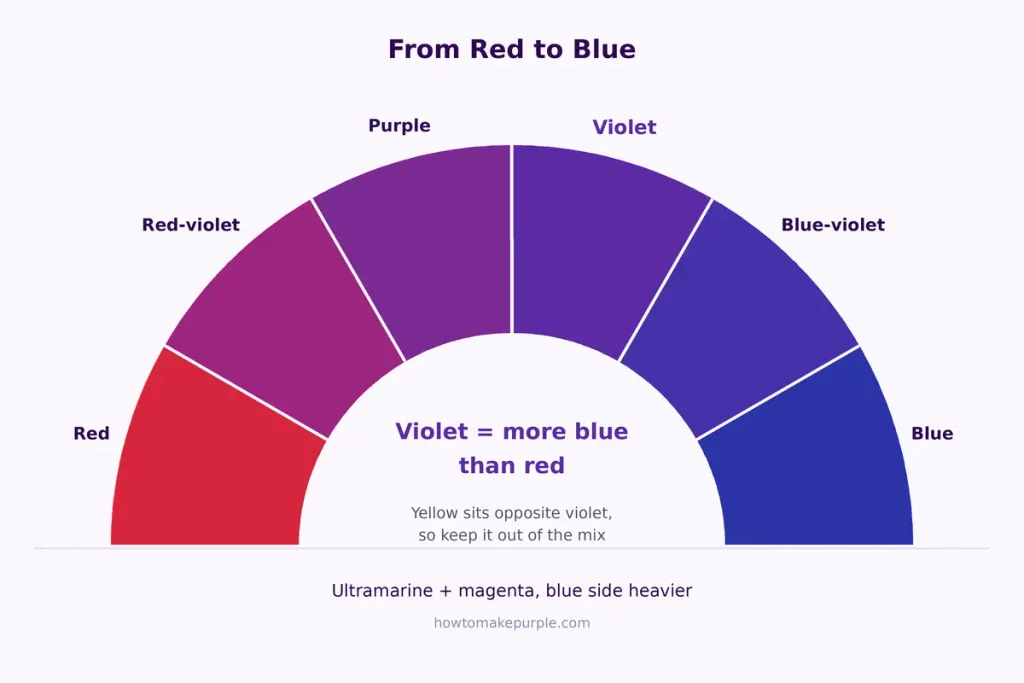
Blue and red make violet, with more blue than red. That one detail separates violet from purple, which uses blue and red in roughly equal amounts.
The kind of blue and red matters as much as the amount. Every paint leans a little toward one of its neighbors on the color wheel, and painters call this color bias. Ultramarine is a blue that leans slightly red, and quinacridone magenta is a red that leans slightly blue. Both already lean toward violet, so the mix stays clean.
Trouble starts with a red that leans orange, such as cadmium red. Orange carries a bit of yellow, and yellow is the complement of violet. Even a small amount of a complement dulls the mix, which is why so many first tries turn grey or brown.
Where Violet Sits on the Color Wheel
Between red and blue, the wheel runs from red-violet through purple and violet to blue-violet. This blue-purple shade sits on the blue side of that range, right next to blue-violet. Yellow sits directly across from it, so keep yellow paint and yellow-leaning reds away from your violet. Color wheels name these steps a little differently, and our purple color theory guide explains why.
How to Make Violet Color With Only Red, Blue and Yellow
Many kids’ and student paint sets come with one red, one blue and one yellow, and that red usually leans orange. You can still get a violet from a set like this. It will just look a little softer than one mixed from magenta.
- Pick the coolest red you have. If one red looks more pink or crimson than the others, use that one.
- Use two to three times more blue than red, since a warm red pushes the mix toward purple fast.
- Keep the yellow off your brush and out of your rinse water.
- If the set includes pink, use it in place of red. Pink paint often contains magenta, so it mixes a cleaner violet.
How Much Blue and Red Make Violet?
Start with 2 parts ultramarine blue to 1 part quinacridone magenta. For a small test, squeeze out two pea-size dots of ultramarine and one pea-size dot of magenta, then mix. From there, shift the balance to move toward blue-violet or red-violet.
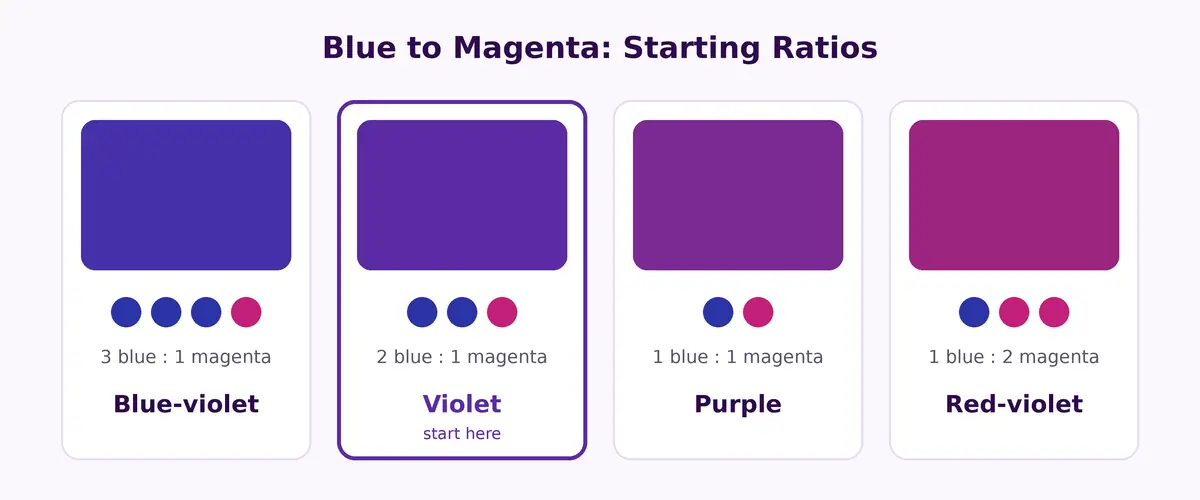
| Target | Ultramarine | Magenta | What you get |
| Blue-violet | 3 parts | 1 part | Cool, close to blue |
| Violet | 2 parts | 1 part | Clear, blue-leaning violet |
| Purple | 1 part | 1 part | Balanced, not violet |
| Red-violet | 1 part | 2 parts | Warm, close to magenta |
TIP- These are starting ratios, not fixed formulas. Magenta is a strong tinter, so in some brands you need even less of it. Mix a swatch, let it dry and adjust.
Not sure whether your mix is violet or purple yet? Use this quick check on your swatch.
| Color | Starting ratio | How it looks | In the rainbow? |
| Violet | 2 blue : 1 magenta | Leans blue, cool | Yes |
| Purple | 1 blue : 1 magenta | Balanced, between red and blue | No |
Save This Violet Mixing Chart
Keep these numbers next to your palette with the cheat sheet below. It shows the four starting ratios, the white tint ladder for light violet, two ways to deepen without black, the three paints to buy and the four quick fixes from this guide.
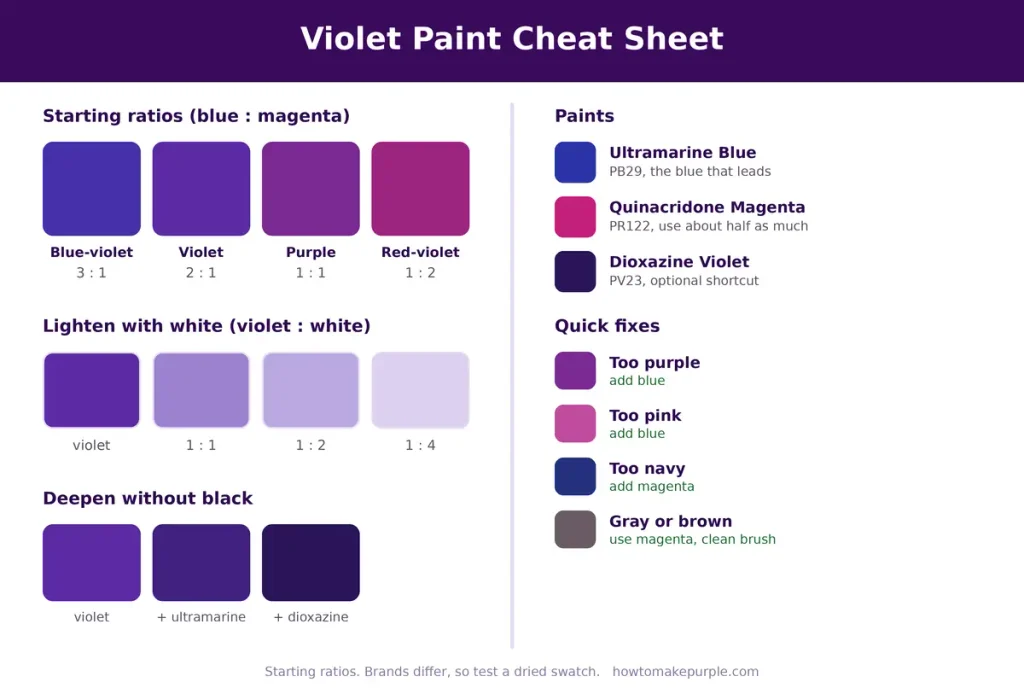
On a phone, press and hold the chart and choose save. On a computer, right-click it and save the image, then print it at any size.
How to Make Violet Color Step by Step
Here is the full method, from setting out paint to checking the dried result. This is how to make the color violet in acrylic, oil and gouache, and water color needs only small changes that you will find further down.
Paints You Need
- Ultramarine blue (PB29)
- Quinacridone magenta (PR122)
- Titanium white for acrylic or oil, or clean water for water color
- A palette knife or an old brush for mixing
- White paper for test swatches
- Optional: dioxazine violet (PV23) for deeper violet
Mix It in 5 Steps
- Put the blue down first. It is the larger part, and starting with it keeps you from overshooting into purple.
- Add magenta in small amounts, each about half the size of your blue.
- Mix with a palette knife until no streaks of blue or pink show.
- Brush a swatch next to a plain purple made from equal parts of both paints. Your violet should look clearly bluer.
- Let the swatch dry, then adjust with tiny amounts of blue or magenta. Once you like it, mix enough for the whole area and write down the ratio, since a second batch rarely matches by eye.
Best Blue and Red Paints for Mixing Violet
You only need two tubes to mix a clean violet, plus one optional shortcut. Here is what to buy and what to leave on the shelf.
| Role | Paint | Code on tube | Why |
| Blue | Ultramarine Blue | PB29 | Leans red, mixes a clean violet |
| Red | Quinacridone Magenta | PR122 | Leans blue, strong, so use less |
| Shortcut | Dioxazine Violet | PV23 | Ready-made deep violet |
| Skip | Cadmium Red or any orange-red | varies | Leans yellow and makes mud |
How to Read the Code on a Paint Tube
Artist paints list their pigment as a short code on the label, such as PB29 for ultramarine blue or PR122 for quinacridone magenta. PB stands for pigment blue and PR for pigment red, and the number points to one exact pigment. Paint names change from brand to brand, so the code is the most reliable way to buy the right tube. The Handprint pigment reference lists these codes if you want to look one up.
Should You Buy a Ready-Made Violet?
If you would rather skip mixing, dioxazine violet (PV23) is the most common ready-made option, and it saves time when you need to cover a large area or match a color across several sessions. It is very strong, so a tiny amount goes a long way. Softer options exist too, such as quinacridone violet (PV19) for a red-violet and ultramarine violet (PV15) for a gentle, slightly grainy violet.
Check the lightfastness rating on any tube before you buy it. Mixing your own still gives you more control over how blue or red the violet leans. Our guide to purple paint pigments and ratios lists more paint options.
How Do You Make Light Violet?
Add white to violet in steps. Start with equal parts violet and white, then try 1 part violet to 2 parts white, and 1 to 4 for a very pale tint.
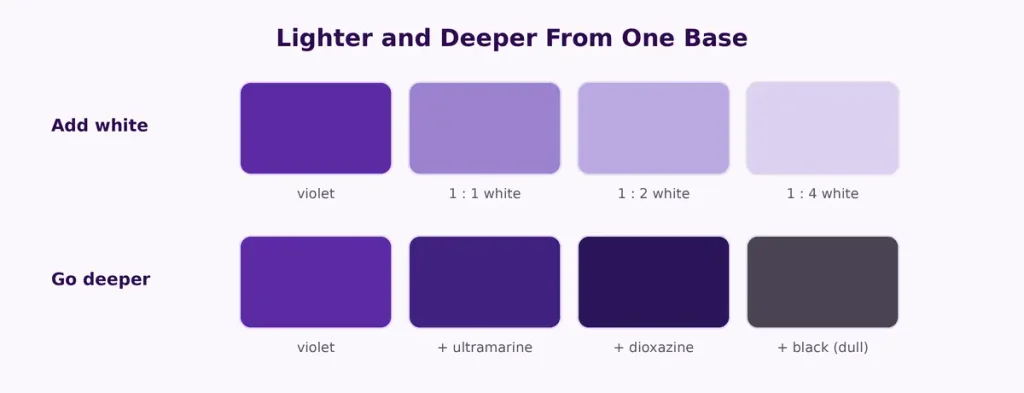
Add the white to the violet, not the other way around. Ultramarine and magenta are both stronger than white, so starting from a pile of white wastes paint. Titanium white can also make violet look cooler and a little chalky. If that happens, add a speck of magenta back to bring the warmth up.
In water color, skip the white. Add water to thin the mix and let the paper show through. A very pale, soft violet starts to look like lavender, and if you want a pinker pale tone, see our guide to light purple.
Dark Violet Without Black or Mud
To darken violet, add more ultramarine or a very small touch of dioxazine violet. Both lower the value and keep the color rich.
Black is the tempting shortcut, but it greys violet out quickly. Save it for times when you want a muted, smoky violet on purpose. Add any darkener a little at a time, because a dark violet is hard to bring back. The same approach works for purple, and our guide on how to deepen without muddiness walks through it.
Blue Violet and Red Violet Ratios
Blue violet and red violet sit on either side of violet, and you can mix both from the same two paints.
- Blue violet: 3 parts ultramarine to 1 part magenta. It looks close to blue with a soft purple glow. Indigo is its darker, deeper neighbor.
- Red violet: 1 part ultramarine to 2 parts magenta. For a cleaner red violet straight from the tube, try quinacridone violet (PV19).
Mixing Violet in Acrylic, Watercolor and Oil
The 2:1 ratio works in all three mediums, but each one behaves a little differently on the palette and on the surface.
Acrylic
Acrylic often dries a little darker than it looks when wet, because the binder turns from milky to clear as it dries. Judge your violet on a dried swatch. Mix enough for the whole area before you start, since acrylic also dries fast on the palette.
Water color
Ultramarine granulates in watercolor, which means its particles settle into the paper and leave a soft, grainy texture. That texture looks lovely in violet skies and shadows. You can mix both paints on the palette, or lay down blue first, let it dry and glaze a thin wash of magenta over it.
Oil
Oil gives you time, so use a palette knife to mix exact amounts and keep the ratio steady. Add white only after the hue looks right, because white shifts both the value and the lean of the mix.
Violet Mixes for Real Projects
Ratios make more sense once you see them in an actual painting. Here are three common projects and how to mix violet for each one.
Flower Petals in Acrylic
For violets, irises or pansies, mix two pea-size dots of ultramarine with one of magenta. Add a touch of white to part of that mix for the petal edges that catch the light, and keep the pure mix for the shadow near the center. A tiny extra dot of ultramarine in the darkest folds adds depth without black.
Night Sky in Watercolor
Wet the paper and lay a wash of ultramarine across the top. While it is still damp, drop in magenta at about half the amount of blue and let the two blend on the paper. The ultramarine granulates as it dries, which gives the sky a soft, starry texture.
Coloring With Markers or Pencils
Most kids’ marker sets skip a true violet. Color the area blue first, then go over it lightly with pink or magenta. With colored pencils, two light layers look cleaner than one heavy layer, so build the color slowly.
Why Does My Violet Look Purple, Pink or Muddy?
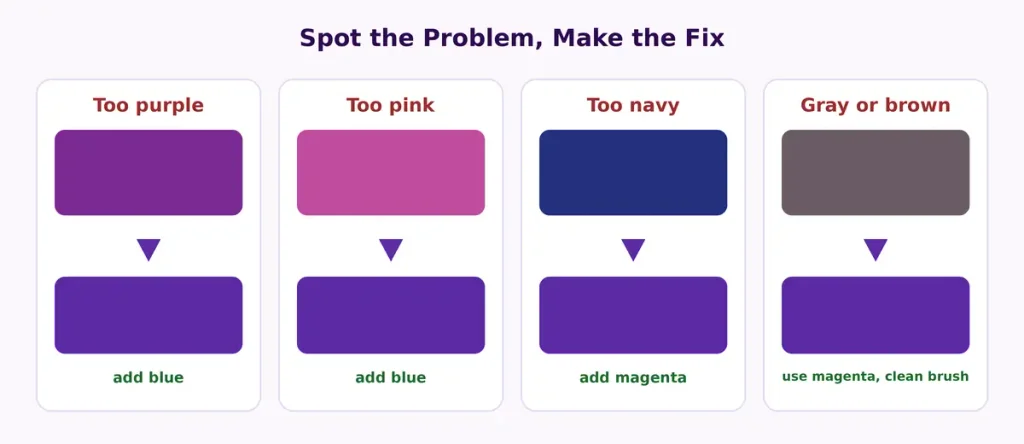
Almost every violet problem comes from the balance between the two paints, or from a third color sneaking in. Find your symptom below and fix it in a few strokes.
Violet Looks Like Plain Purple
There is too much red in the mix. Add ultramarine in small steps and check a swatch after each addition. If you started from a 1:1 mix, you made purple, so double the blue.
Violet Looks Pink
Magenta is overpowering the blue. Add more ultramarine. If the batch is already large and still pink, starting a new one with less magenta is often faster.
Violet Looks Navy
Too much blue, or a very strong blue like phthalo blue (PB15). Add a touch of magenta. If you used phthalo, switch to ultramarine, which is gentler and already leans toward violet.
Violet Looks Gray or Brown
A warm red, a speck of yellow on the brush, or black is usually to blame. Switch to magenta, rinse your brush and water, and start a fresh mix. You will find more fixes for dull mixes in our guide on why purple paint looks brown.
Violet Color Codes: HEX and RGB
If you design on a screen, these are the violet values you will see most often. Screens can show a brighter violet than any paint can mix, so use these as screen references and mix paint by eye.
| Name | HEX | RGB | Note |
| Vivid violet | #8F00FF | 143, 0, 255 | Common reference value, also called electric violet |
| dark violet (CSS) | #9400D3 | 148, 0, 211 | Official CSS named color |
| blue violet (CSS) | #8A2BE2 | 138, 43, 226 | Official CSS named color |
| violet (CSS) | #EE82EE | 238, 130, 238 | Official CSS named color, a light pink-violet |
Watch out for the CSS name “violet”. In the W3C CSS Color specification, violet is #EE82EE, a light pink-violet. If you want a deep, vivid violet in your design, use dark violet or a value like #8F00FF. Our purple color codes page lists more shades.
Is Violet the Same as Purple?
No. Violet leans blue, while purple sits evenly between red and blue. On your palette, the difference is the ratio. Two parts blue to one part magenta gives violet, and equal parts give purple.
The difference shows up in light too. Rainbow violet is a real spectral color, found at the short end of visible light at about 380 to 450 nanometers. Purple does not appear in the rainbow at all. Your eyes see purple when red and blue light reach them together.
A paint mixture gets close to rainbow violet, though no pigment matches the glow of pure light. Paint makers also use both names loosely, so a tube labeled purple can look violet. When in doubt, read the pigment code. For a closer look, see the full difference between violet and purple.
Frequently Asked Questions About Violet Color
Get a Clear Violet Every Time
Now you know how to make violet color that stays violet. Let the blue lead, add magenta in small steps, and judge a dried swatch before you commit. Save the chart, keep it by your palette, and meet the rest of the family in our guide to other shades of purple.
Z- Written and reviewed by Zohan, founder and editor of How to Make Purple. This guide was researched from manufacturer pigment information and established color references. Mixing results vary by brand, surface and lighting.
Last reviewed: October 15, 2026.